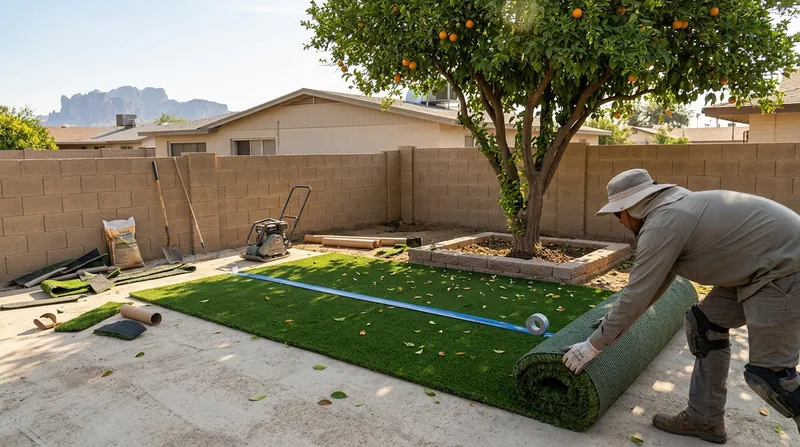




Residential artificial grass installation in Mesa transforms patchy bermuda lawns and bare dirt yards into dense, realistic turf that handles 115-degree East Valley summers without fading, browning, or the water bills that keep native sod alive in the Salt River Valley. From 1950s ranch homes in West Mesa to the newer master plans near Eastmark and the hillside golf communities of Las Sendas, Mesa homeowners face the same hard choice: invest in flood-irrigated bermuda that dies back in winter and scorches in July, or convert to synthetic turf built for this heat and this terrain. We install artificial grass on front and back yards across Mesa with a decomposed granite base over caliche, drainage tested before the turf goes down, and edges anchored for monsoon winds that tear loose corners on poorly installed systems. Every job comes with a written spec naming the turf product, face weight, pile height, infill type and pounds per square foot, and base depth so you know exactly what you're getting.
Why Residential Artificial Grass Installation Matters in Mesa's High-Heat Climate
Mesa summers routinely exceed 110 degrees, and real bermuda lawns struggle under that stress even with daily irrigation. Flood-irrigated lots in West Mesa and downtown neighborhoods were designed for citrus and alfalfa, not turf, and the basin systems that worked for those crops create standing water problems that kill grass roots. Synthetic turf eliminates the water dependency, handles the heat without stress, and stays green year-round in a city where winter visitors expect a landscape that looks alive in January. The Superstition Mountains and the Usery range frame the valley, and in the shadow of those ridges, homeowners in northeast Mesa and the hillside communities find that real grass simply cannot compete with afternoon sun bounce and reflected heat off tan stucco walls.
- Eliminates the need for daily irrigation during 115-degree summer heat waves that stress and brown out native bermuda.
- Handles monsoon dust storms and the alkaline, caliche-heavy soil without compaction or drainage failure if base prep is done right.
- Stays dense and green through Mesa winters when real grass goes dormant and bare patches invite weeds.
- Anchored edges and reinforced seams resist the wind gusts that tear loose artificial turf installed on bare dirt or shallow base.
- Works on flood-irrigated lots where standing water kills sod roots but drains safely under turf if subsurface prep is correct.
The key is getting the base and drainage right from the start so your turf lasts and performs.
Key info: Mesa's caliche layer sits 8 to 18 inches below grade depending on location. Homes in West Mesa near downtown and in the Dobson Ranch and Alta Mesa communities often have flood-irrigation basins that hold water. We test drainage before installation and adjust base depth and underlayment to move water away from the turf and away from home foundations. A shallow 2-inch base over caliche fails in monsoon season. We build 4 to 6 inches.
For more on how turf works in Mesa's specific climate and soil, visit our homepage to understand the full scope of what we do across residential yards, commercial properties, and specialty applications like pet turf and dog runs.
How We Install Residential Artificial Grass: The Mesa Process
Our installation process starts with an on-site visit to assess the yard, soil condition, drainage, sun exposure, and any HOA restrictions that apply to front-yard turf. We request Arizona 811 utility locates to mark public lines, then remove existing sod or dirt, build the decomposed granite base, and compact it to spec. Edges are anchored with landscape fabric and stakes, seams are glued and heat-welded, and infill is spread and brushed to final density. The whole job from start to finish on a typical 400-square-foot yard takes two to three days depending on base prep and whether we're working around patios, pools, or landscape features.
- We remove old sod and inspect the subsurface for caliche, clay layers, and drainage problems before any new material goes down.
- We build a 4 to 6-inch decomposed granite base, compact it, and test it to make sure water moves away from foundations and patios.
- We lay landscape fabric to separate the base from the turf and prevent infill migration into the soil below.
- We position the turf, glue and heat-weld seams, and anchor all edges with stakes and landscape staples so monsoon winds cannot lift corners.
- We spread and brush the infill (typically zeolite, silica sand, or recycled rubber) to the engineered density for that turf product.
- We inspect the final surface, check drainage, and walk you through maintenance and care.
Every installation comes with a written spec and a one-to-three-year workmanship warranty on our labor.
Local example: A 600-square-foot backyard in Las Sendas with a hillside slope and a patio near the back door took three days because we had to grade the slope, build up the base on the high side, and tie the turf edge into the patio with a metal trim. A flat 400-square-foot yard in West Mesa with good drainage took one day. Complexity and terrain drive the timeline.
Learn more about our approach to other residential applications like pool surround turf and patio and balcony installations where hard-surface drainage and edge details matter just as much.
Installation Methods and Base Specifications for Mesa Residential Yards
| Approach | Description | Best For |
|---|---|---|
| Full excavation with 4-6 inch DG base | Remove existing sod, build compacted decomposed granite base over caliche, add landscape fabric, lay turf, and anchor edges. | Yards with poor drainage, caliche near surface, or flood-irrigated lots in West Mesa and downtown Mesa where subsurface water management is critical. |
| Existing base retrofit | If existing hardscape base (paver base, sand) is in place and stable, we add landscape fabric, level and compact the surface, then lay turf and secure edges. | Yards where sod has been removed and a usable base already exists, or where digging is limited by utilities or structures. |
| Sloped or graded installation | Build base to match existing grade or create controlled slope for drainage, compact in lifts, and secure turf with additional edge stakes on slopes. | Hillside homes in Las Sendas, Red Mountain Ranch, and northeast Mesa where terrain is uneven and water must drain away from structures. |
| Basin preservation for flood-irrigated lots | Build base and install turf while maintaining the basin shape and subsurface drainage so water still moves as designed but turf prevents erosion and mud. | Flood-irrigated properties in West Mesa and older neighborhoods where the irrigation basin is part of the lot's water management. |
Residential Artificial Grass Installation Cost in Mesa: What to Expect
Artificial turf installation in Mesa typically runs from $8 to $14 per square foot installed, depending on base prep complexity, existing site conditions, and the turf product you select. A 400-square-foot backyard on a flat lot with good drainage and no obstacles might land at the lower end of that range, while a 1,000-square-foot yard with slope, caliche removal, and complex edge details will run higher. The biggest cost drivers are base depth and compaction (essential in Mesa's caliche-heavy soil), seam count and heat-welding (more seams mean more labor), and infill type and volume. A yard that requires significant grading, drainage correction, or removal of existing hardscape will also increase the estimate.
We recommend getting two to three written estimates from turf installers so you can compare the base spec, turf product, and infill details side by side. A quote that looks cheap often reflects shallow base, low face-weight turf, or light infill that will fail in monsoon season or under Phoenix sun. Visit our pricing page for detailed cost ranges on common yard sizes and scenarios specific to Mesa.
Cost reality: A 500-square-foot yard in a West Mesa flood-irrigated lot with caliche at 10 inches and existing bermuda sod will cost more than the same size yard on a new Eastmark lot with good fill and no subsurface water. Drainage work is not optional in Mesa. If your estimate includes a 2-inch base or no mention of drainage testing, walk away.
What to Look for When Hiring a Residential Artificial Grass Installation Company Near Me in Mesa
Hiring the right turf installer in Mesa means vetting not just price but the quality of the base, the product spec, and the company's track record. Many crews across Phoenix and the East Valley lay 40-ounce turf on bare dirt with minimal base and move to the next job, leaving homeowners with seams that separate in summer heat, edges that lift in monsoon winds, and infill that migrates into the soil. A professional turf installation company provides a written specification naming the turf product, face weight, pile height, infill type and pounds per square foot, and base depth in inches before work starts. Ask for references, photos of finished work, and a certificate of insurance naming general liability and workers compensation.
- Request a written spec that names the turf product, face weight, pile height, infill type, infill density in pounds per square foot, and base depth before you sign.
- Ask for at least three references from Mesa-area residential jobs completed in the last two years and call or visit those yards to inspect the seams and edge anchoring.
- Verify that the installer has a local address, a phone number answered by a real person, and a certificate of insurance covering general liability and workers compensation.
- Check whether your front-yard turf needs HOA approval and ask the installer to help you understand what color, pile height, and edge details your HOA requires, though they cannot guarantee approval.
- Confirm that the estimate includes base prep, drainage testing, edge anchoring, seam heat-welding, and infill spreading so you are not surprised by add-on charges later.
- Ask about the warranty on workmanship (typically one to three years on installation labor) and understand that manufacturer warranties on the turf itself are separate and are not claimed by the installer.
A turf installer who refuses to put the base spec in writing or who cannot name the exact infill product and density is not the one to hire.
Ready to get a free estimate on your Mesa yard? Contact us today and we will walk through your site, answer your questions, and provide a detailed written estimate with no obligation to book.
Residential Artificial Grass Installation in Mesa: Pricing Guide
| Service | Price | Details |
|---|---|---|
| Residential yard installation (400-600 sq ft) | Starting at $8/sq ft | Includes removal of existing sod, 4-inch DG base, landscape fabric, turf, seams, edge anchoring, and standard infill spreading on flat terrain. |
| Residential yard installation (600-1000 sq ft) | Starting at $9/sq ft | Includes full base prep, drainage testing, and additional labor for seam count and edge complexity that increases with yard size. |
| Complex terrain, slope, or drainage correction | Starting at $11/sq ft | Grading, caliche removal, deeper base (5-6 inches), additional compaction, and subsurface drainage work in hillside or flood-irrigated yards. |
| Premium turf product or specialty infill | Add $1-3/sq ft | Higher face weight turf, heat-rated products, antimicrobial or pet-specific infill, and recycled rubber alternatives increase material and installation cost. |
| Free estimate | No charge | On-site visit, written spec, and quote delivered within 24 hours by phone or email, no obligation to book a job. |
Indicative pricing, the exact cost depends on square footage, finish, and site access. Free personalized estimate within 24h at (480) 452-1014.


